An Art and Method for Ecological Sustainability
by Danny C. Shelton
“You didn’t come into this world. You came out of it, like a wave from the ocean. You are not a stranger here.” ~ Alan W. Watts
Among our most basic needs as human beings is that of being accepted by others of the society in which we live. As we develop, our need for acceptance expands into greater circles of interrelationship with other people. Through maturity, we further develop understandings of cultural variations and recognize what is shared in-common between greater variations of cultural practices. It is this search and discovery of what is shared in-common, among cultural variation and diversity, that we may sense, recognize, and rediscover our greater shared sense of belonging in Nature. The word common has its roots in the concept of equally belonging and shared alike. It is the root of the word community, and most importantly of communion, or that which is shared in-common through participation in direct natural sensory relationship.
Continue Reading →
posted by Thomas Joseph Doherty, Psy.D.
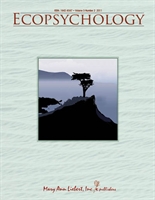
To recognize Earth Day, I am proud to announce the launch of Ecopsychology, a new, quarterly online peer-reviewed journal from Liebert Publishing. You can download free articles from the first issue Continue Reading →
by Robert Greenway
(continued from Part 1)
Thanks for all the interest in “defining” – I think it very important, for a variety of reasons. Not to “lock in ‘the field’”; not assuming that “nature” needs us to be conceptual or heady; not to provide public credentials (that after all serve a culture with symptoms of serious disjunction); not to push a certain philosophy over another; but simply as an “interim” tool — with which those who in fact have worked out a healthy “human-nature-relationship” can do more than blather incoherently (or eschew all guides and forward references) in service to a kind of naturalistic Boddhisatva vow — that we will not take our exploitative comforts and pleasures [for granted] until all humans and creatures and life can live in alignment with “nature”.
There is no common definition of “ecopsychology” – to many, in and out of academia, it has come to mean any or all of the following: a kind of “pop psychology” or quasi therapy that helps ease fears about the decline of “the natural world”; just about any kind of environmental-social or environmental-political topic; gardening, hikes in the wilderness, fishing – anything having to do with “humans” and “nature” (with “nature” usually meaning something separate from humans). Etc.
Continue Reading →
by Robin Gates
Western culture has a history of union and subsequent separation from nature. This split between spirit and nature, psyche and soma, intellect and emotion, science, philosophy, and religion, manifests in our individual and collective consciousness creating crises that span the spectrum of human experience, from the psychological to the environmental. Since we have within our unconscious memories of our being in union with nature, it is a matter of recovering them through what Carl Jung called the individuation process; whereby, a person develops one’s unique individuality from that which has been imposed on him or her from the environment. An expansion of consciousness and recovery of the eco-unconscious is achieved by the confrontation with and integration of unconscious material culminating in coniunctio, or union of the opposites. To read the whole essay, download the pdf.
=================
Robin M. Gates is a student in the Psychology Department at Pacifica Graduate Institute, CA, where he is pursuing a Ph.D. in Depth Psychology. He holds an M.A. in Psychology and a B.A. in Philosophy and has been teaching at the college level for over 10 years. This article came as a response to a personal healing journey from an illness which lasted over seven years.
Immersing yourself in the wildness, magic and history of Britain
by Daniel Start
When I was young, the rambling old house we shared with two other families came with lakes, woods, streams and an overgrown boat house. Situated deep in the heart of the Wye valley, close to the Welsh border, in the UK, it was here my brother and I first learned to make dams, build rafts and explore the river.
I loved one stream in particular. Gushing and snaking its way down the side of the Black Mountains, its mossy dingles and foxglove-filled dells enchanted me. Plunging into deep pools and sliding down chutes, my brother and I spent much of our summer squealing and slithering along its helter-skelter of cascades.