Clark Mumaw’s paper, An Engineer’s Guide to Better Health and Applied Ecopsychology, describes his studies with Dr Michael Cohen and his Institute of Global Education and shows how he has applied these studies in his own life. Download the pdf here.
Clark grew up in rural farmland in northern Indiana near the conservative Amish settlements. As a young man, his life was interrupted by a stroke, and on dismissal from the hospital Clark needed a wheelchair, due to almost complete paralysis in his left arm and left leg. Clark now finds himself working towards a PhD in eco-psychology, which he plans to use as a new career path teaching others how to benefit from nature like he has. His recovery is progressing well enough to hope for a full recovery. Clark lives in Oxford, OH and may be reached at crumaw@yahoo.com.
by John Wickham
As a child I was perplexed why mountain climbers would return empty-handed. They always ascended as if hunting for something lost or left behind. Then venturing up with my parents to Camels Hump in Vermont, I too looked around. But the journey down lasted 30 years until I climbed back for the meaning of the summit.
Still a youth, my descent from the mountain began with a emotional detour. I weathered internal, opposing forces. While discovering the passion of the guitar and composing, I was playing war with friends as soldier-boys. As a young adult I pursued both vocations, music and the Army. But lurking in the underworld were the disharmony and battles for my soul. Psychic-combat left no victors, only a downward trail into fog and darkness.
My last Army duty was at Fort Carson, Colorado. The Post sits like an armpit wedged between the Great Plains and the jutting Rocky Mountains. Fierce lightning storms would often park there in the Summer. It was then I felt a magnetic tug upwards to misty peaks that seemed to pierce through into sunlight.
by Catriona MacGregor
“Partnering With Nature”
Receives 2010
Best “Social Change Book” Award
A simple book with a powerful message that illuminates the fact that our connection to nature, animals, and the earth is a vital part of our existence.
by Ben de Vries
As we take control of the course of our lives and communities to create new more viable futures for ourselves, problems emerging from the existing system(s) may follow us if we let them. Our current capitalist, militarist, imperialist system is based upon a hierarchy of those with capital and power exploiting those who don’t. This hierarchy pervades every aspect of our existence so long as we are living by it, and the problem I wish to address in this article is features of this system that might be carried into future systems, and the difficulties interfacing any new system into the existing one.
by Leon Miller
It is possible to have a more advantageous view of nature by maintaining a perceptual focus on what enhances the human experience while avoiding that which diminishes human well-being.
Introduction
Humanity’s understanding of the nature of existence is primarily based on perception. Humanity has long held a perspective on existence where nature and human culture exist in dichotomy. But this perspective of nature has not always been the view through which humanity perceived and experienced the environment and is not the only view through which the nature-human relationship is based. It is clearly possible and preferable to have a perspective that allows taking advantage of nature’s signaled opportunities for flourishing while avoiding what would diminish human well-being. Being able to take advantage of this improved nature-human relationship is a matter of perception.
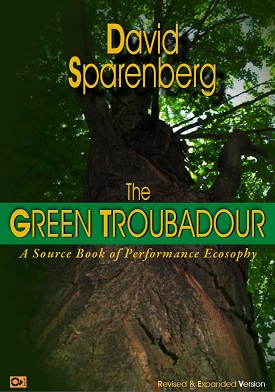
by David Sparenberg
Since Bach first made a fugue
the simplest melody of a flute
on a hill
has been looked on as poverty.
But a hill is not poverty.
Day, daylight, the sun, seasons
air
breathed through the flute player, sent
dancing through the wooden throat
of a finger-holed flute—
this is not poverty. Go aside
‘til you find the paradise of simplicity.
Ask yourselves there in that
kingdom of God:
What is the worth of philosophy?
What is the truth of ecosophy? Continue Reading →
Prayer Of the Animals
by David Sparenberg
Our kin,
who now possess the land
where once we roamed,
plentiful and free,
lead us not into extinction,
but deliver us from the devouring
dis-ease of human greed.
Give us this day
(even unto the seventh generation)
a belonging-place to be
what we are, and in harmony
with All Our Relations.
For yours is the power
to restore or further destroy
the Sacred Hoop of Creation.
Make a warrior’s choice
by honoring unity in diversity
of the Great Mystery.
Let Spirit guide you
back to Creator’s vision-dream:
We Are All One Family.
by David Sparenberg
We progressed until we reached the latest rung in the Inferno. There before us were two seething pits of new made hell, carved like gouged eye sockets in the fearsome, rude desolation of blind punishment.
The first of such was as a lake, thick and deep with blood. Over this body of violence an angry wind whipped in bursts of crazed fury and waved in rippling obscenities of gurgling cries, gagging groans and ugly screams of pleading agony. Awash in the blood thick muck, swilling and knotted into fist sized clumps, circulated currencies of all the world—some nations contributing more to the horror, while others less.

Healing Natures, Repairing Relationships by Robert France brings together a leading group of distinctive voices to explore ideas underlying the restoration of environmental and human integrity in what pioneer restorationist Aldo Leopold once called our damaged “world of wounds.” This emerging paradigm—referred to by the editor as “Restoration Design”—is defined as the process by which participants creatively develop physical and conceptual relationships to engage nature through the architectural transformation of their inhabited ecological space as well as their internal environments. In this collection of essays, restoration design is shown to be a comprehensive process involving elements of sociology, anthropology, philosophy, ecopsychology, environmental art, ecological science, and landscape architecture. Continue Reading →
Submitted by Citt Williams
An invitation from Our World 2.0:
Our video collection “Indigenous Perspectives of Climate Change”, made collaboratively with communities and researchers in 2008-9, documents several important traditional knowledge perspectives of environmental change. Of particular relevance, the video created with FSDA.ru in the Russia’s Altai Mountains “Land has Breath” and another with Marilyn Wallace from the Wet tropics of Far North Australia “Walking on Country with Spirits”.
All of our written and video work is creative commons and is available for wide online sharing, embedding, teaching and discussion. We invite you take a look at Our World 2.0
Continue Reading →
Submitted by Martin T Brown, of Third Planet Pictures:
A new film by Emmy Award winning director Jan Nickman, titled “Sacred Earth“, moves beyond the discussion “about” nature and instead takes the viewer into a deeply personal experience “with” nature.
Here’s a trailer:
by Daniel Schwab
This is a delightful exposition of the themes explored by an avid student of Life in his Senior Thesis for Evergreen State College. Daniel’s range includes the environment, design, mathematics, biophilia, pattern, modern technology, and community. Download pdfs for Daniel’s introduction and visual summary.
a poem by Mary Sokol, PhD
Newly arrived,
this Spring day and I
to this place.
I,
walking the perimeter
exploring color and texture,
of land,
ground,
forest.
Woods reveal
themselves
to me,
woods,
frame in
my land
frame
my home,
woods defining me.
Continue Reading →
by John Scull
The library had a copy of Al Gore’s new book “Our Choice: A Plan to Solve the Climate Crisis.” It’s a glossy book full of coloured pictures and laid out like a very thick magazine. He goes through various options for dealing with climate change, reviewing the research, supplying facts and figures, and telling histories.
The book goes on to discuss “the obstacles we need to overcome” and “going
far quickly” but I haven’t read these sections yet.
From what I have read so far, I feel this book is good for informing people who are concerned about climate change and want to do the right thing and support effective policies. I doubt if it will have much effect on the unconvinced.
John Scull
www.naturecowichan.net
“I believe a leaf of grass is no less than the journey-work of the stars.”
~ Walt Whitman
Everything you need to know about planning and starting your home garden can be found at this handy site: homeservicesengine.com